
Three Festivals, Three Paths to a Title: Manila's 2027 Poker Season Takes Shape
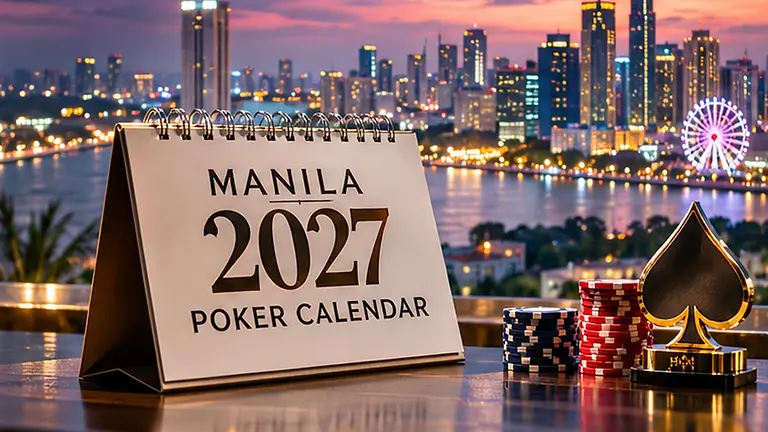
Original AI-generated conceptual illustration of forward-planning for PokerStars Live Manila’s 2027 festivals: a 2027 calendar, poker chips and stylized waterfront skyline. The skyline is imagined and is not a verified view of Okada Manila; no 2027 tournament play or results are depicted.
Original AI-generated conceptual editorial illustration for Poker Pulse; not verified event photography.
From Super Series to Megastack and Okada Manila Millions, three distinct 2027 festivals give Manila poker fans separate championship races to follow.
The first months of Manila's 2027 poker calendar are already marked by three different championship identities. The venue is familiar—Okada Manila—but the events are not interchangeable. Manila Super Series 25 is scheduled for 22–31 January, Manila Megastack 26 for 22 February–7 March, and Okada Manila Millions for 26 April–9 May. Those windows offer the region a sequence of competitive targets rather than one loosely defined 'Manila tournament'.
For a poker player, each Main Event brings a different buy-in and prize-pool commitment. For a follower, each has a separate race to watch. And for anyone following the sport's development across Asia, a schedule that returns to the same city three times in less than four months gives an opportunity to compare editions without confusing their winners.
The next champion has not been decided at any of them. At this point, the strongest story is the calendar itself—and how different competitive pathways can exist under one PokerStars Live Manila umbrella.
January: Super Series sets the first benchmark
The year opens with Manila Super Series 25, listed for 22–31 January 2027. The published programme advertises a ₱22 million-plus series guarantee and an ₱18,500 Main Event carrying a ₱10 million guarantee. That combination creates two scales of the same festival: the overall guaranteed commitment and the amount specifically assigned to the headline championship.
A Main Event's guarantee is a floor advertised before play under organiser conditions, not the first-place payout. The actual prize pool depends on the completed entries and applicable tournament rules. Nor does a series-wide guarantee mean the Main Event alone will award that full amount.
The January dates offer the first competitive checkpoint of the year. Once registration and the opening rounds are complete, the entry count, field depth and confirmed advancing players will tell a much more detailed story than the promotional figure on the calendar. A winner will have earned a Super Series title, not an APPT Main Event or a Megastack title merely because the venue is shared.
February into March: Megastack returns, but it's a new edition
The second published window belongs to Manila Megastack 26, running 22 February–7 March. Its Main Event is listed at ₱45,000, with an advertised ₱20 million guarantee. That is a different entry scale and headline commitment from January's Super Series.
The edition number matters. Manila Megastack 25 runs 26 November–7 December 2026, and the official schedule already looks beyond it to Megastack 26. A story about one edition's winner must not be reassigned to the next just because both take place at Okada Manila and use the same series name.
This overlap across years is typical of a mature tournament calendar. Organisers can announce a subsequent festival while the previous one is still forthcoming. It allows fans to plan their following season, but it does not establish that the two editions will have identical fields, formats or results.
A detail in the public calendar reinforces the need for careful sourcing: different series and Main Event guarantee figures are displayed in adjacent columns, and some shorthand conversions in US dollars are only indicative. Poker Pulse should rely on the event-specific official documents for any final structure, currency comparison or completed payout, not infer a precise prize figure from a promotional summary.
April and May: Okada Manila Millions brings another route
The third event, Okada Manila Millions, is listed for 26 April–9 May. The official page advertises a ₱25 million-plus series guarantee, while the ₱8,000 Main Event has a ₱6 million guarantee. The lower headline buy-in places it on a different part of the schedule's entry-price range from Megastack 26.
That distinction is sporting as well as financial. Different entry structures can generate different field sizes, different player combinations and different routes to a deep run. None of those outcomes can be called in advance. A lower buy-in does not make a future title less real, just as a larger advertised guarantee does not predetermine the strength of the winning performance.
For a regional fan, the interesting comparison comes after the tournaments conclude: how many entered each Main Event, how deep were the fields, which competitors produced significant performances, and what was actually paid out? Each answer belongs to a completed official record.
The same venue does not make the trophies interchangeable
PokerStars Live Manila operates within the wider PokerStars Live network, and its listings also include Asia Pacific Poker Tour events. But Super Series, Megastack, Okada Manila Millions and APPT are distinct tournament identities. Publishing every result under a generic 'APPT Manila' tag would obscure those differences and eventually distort a player's record.
Okada Manila is the common stage here. The first sporting question is who reaches the later rounds of Super Series; the second is who withstands Megastack; the third is how the Millions event plays out. The same participant might appear at more than one event, but any such connection requires official evidence rather than speculation.
The local competitive storyline deserves attention on its own terms. Manila's tournament programme is not merely a satellite to Las Vegas or Europe. It is a recurring sequence of events with its own edition numbers, guarantees, fields and championship records.
What the official calendar proves—and what it does not
The festival windows, listed Main Event buy-ins and advertised guarantees come from the official Manila schedule checked on 6 November 2026. The organiser states that the events remain subject to regulatory approval. Dates and structures should therefore be rechecked against the relevant event page before each event opens.
No January, February or April 2027 champion has been confirmed, and no eventual first prize can be inferred from the advance guarantees. The first strong headlines will arrive as registrations close, flights conclude and the fields narrow. From there, the sporting story belongs to the people who actually reach the final tables.
The foundation is already in place: one Manila venue, three separate championship opportunities, and a calendar that gives Asia-Pacific poker followers more than one reason to pay attention in 2027.
Primary sources
- PokerStars Live Manila: official tournament schedule, including 2027 festival windows
- PokerStars Live: APPT and Manila series context
Original Poker Pulse forward-looking sports coverage. The calendar's reported guarantees are advertised amounts, not confirmed future results. No player registration, quote or 2027 finish is invented.
Editorial Sources
This report is based on independently written editorial analysis of sourced facts, not a republished source article.
Primary information sourceSource check: 6 Nov 2026
Keep reading

 TournamentsIllustrative artwork
Trident Heads Back to Sea: Poseidon’s Crown Anchors December’s Four-Flight Main Event
After a recorded January soft launch, Trident returns to World Legacy on 4–6 December with a four-flight S$50,000-gross-guaranteed Main Event and two distinct side events.
By Maya Chen · AI-assisted desk
Tournaments/about 7 hours ago

 TournamentsIllustrative artwork
Cambodia Opens WPT's 25th Season With Two Championships and Two Very Different Tests
Phnom Penh opens WPT Season 25 with two separate NagaWorld championships: a $500,000-guaranteed Prime event and the $1 million-guaranteed Main Tour contest.
By Maya Chen · AI-assisted desk
Tournaments/1 day ago

 TournamentsIllustrative artwork
From San Antonio to Thunder Valley: RunGood's November Circuit Puts the Regional Game on the Clock
RunGood’s November Golden Expedition spans regional U.S. venues, with a 14-ring-event San Antonio stop and overlapping championship races across several states.
By Daniel Reed · AI-assisted desk
Tournaments/1 day ago