
Two Hundred and Nine Events, One $5 Million Main Event Test: APT Taipei Sets the Stage
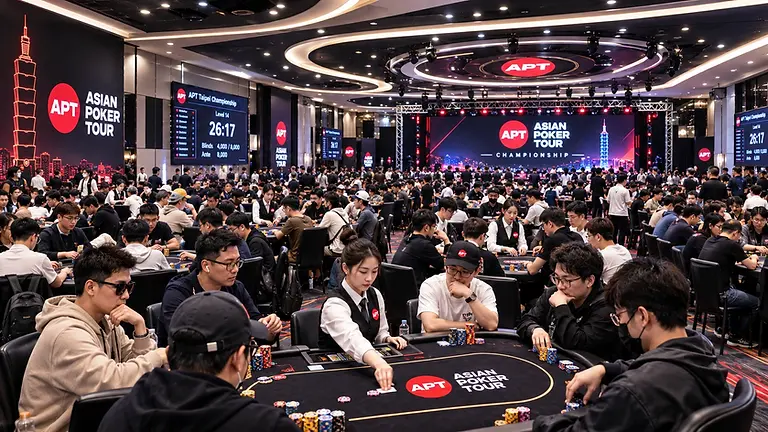
Original AI-generated illustrative tournament scene inspired by a photograph from an earlier APT Taipei event. This is not an authentic photograph of the 13–29 November 2026 APT Taipei Championship; depicted play and displays are imagined.
Original AI-generated Poker Pulse illustration, informed by user-supplied historical APT Taipei reference photography; not documentary event photography.
APT Taipei’s 209-event schedule tests far more than no-limit hold’em, while a US$5 million Main Event guarantee sets up its 17-day championship.
In Taipei, the Asian Poker Tour is preparing a championship whose size creates a different challenge from an ordinary festival preview. The APT Championship 2026 is scheduled from 13–29 November at Red Space, with 209 listed events across 17 days and an advertised US$5 million Main Event guarantee. The scale is impressive, but the deeper story lies in the range of competitions that will unfold beneath the same festival banner.
One poker room can host a string of distinct challenges: a long Main Event campaign, a high-roller contest, a heads-up bracket, a mixed-game title and shorter turbo tournaments. Those games do not reward identical skills or produce interchangeable champions. A publication that treats all 209 entries on the schedule as a single no-limit hold'em tournament would miss almost everything that makes this championship interesting.
The headline guarantee sets expectations. The actual tournament results will establish whether the edition delivers the moments that define it. Those results cannot be supplied before the first championship field finishes registering.
The opening programme shows the festival's range
The organiser's event page offers a detailed example of the tournament mix. The opening days include National Cup Championship flights, a heads-up no-limit hold'em contest capped at 64, pot-limit Omaha, high-roller events and a fixed-limit triple-draw mix. There are also satellites, turbo and hyper-turbo formats, and more specialised games later in the festival.
That breadth means the headlines may emerge in unexpected corners of the schedule. A specialist surviving an unusual mixed-game field can be as significant to their format as a larger no-limit hold'em event is to the general audience. The correct question is not merely how many tournaments are printed in the programme; it is what each named event actually tests.
Even the number 209 needs careful handling. It is the organiser's advertised event count across the schedule, including a complex collection of event entries and formats. It is not proof that 209 separate championships have already been completed or that the festival has already crowned that number of winners. As play proceeds, a scoreboard should be built from actual event results rather than counting calendar rows as completed victories.
The Main Event brings the biggest championship promise
At the centre stands the APT Championship Main Event, advertised with a US$5 million guaranteed prize pool. The guarantee is a pre-event commitment under the official terms, not a confirmed first-place payment and not a completed prize pool. The difference matters when a headline travels beyond dedicated poker readers.
Unlike a single-day tournament, a multi-day Main Event generates several distinct phases: entering the field, surviving an opening stage, navigating later days and finally reaching a table where one decision can change the championship. Those are reasonable expectations based on tournament structure. The specific chip leader, difficult call, elimination and final hand must come from actual tournament updates once they occur.
The advertised figure also distinguishes the Main Event from the National Cup and from side events with their own guarantees. A strong results desk will not attach the Main Event's US-dollar guarantee to a different tournament simply because both appear under APT Championship branding.
A venue with its own identity
The official event information lists Red Space 多元商務空間 in Taipei as the host for the entire championship. That venue matters beyond the address line. It is a distinctive setting for the tour's regional season-end programme and provides a consistent location for an unusually crowded schedule of tournaments.
Historical venue and event photographs can show the style of the tournament floor, but this November's playing scenes must not be invented. A visually researched illustration can prepare readers for the venue's atmosphere without pretending to document an opening field or a winner that has yet to emerge.
Taipei also has a recurring place in the Asian Poker Tour's larger calendar. The organiser's historical series page lists previous Taipei festivals and a future return in 2027. Repeated stops make year-on-year comparisons possible, but the 2026 championship's figures belong to this edition and should not be carried forward as guaranteed structures for next year.
The festival becomes a different story each day
A 17-day schedule demands more than one preview. Early news can be about who enters and which formats attract attention. Once events are completed, individual title reports can follow, with verified field size, champion and prize figures. Mid-festival, the Main Event and high-roller schedules may overlap, creating different results to track at the same time.
The time zone adds another layer. Taipei's official start times are local. An international reader may see a 13 November session while still living through 12 November elsewhere, and a 'today' label on a global news page is therefore not enough evidence to identify the current stage of a tournament.
There is also an important distinction between sporting intrigue and invented narrative. It is fair to anticipate that the championship will test specialists across formats; it is not fair to name likely winners or pretend that an unreported bluff has decided a final table. The sports-writing energy should come from the stakes and the records that exist, then from verified action when the cards are dealt.
Why the result will matter beyond one week
The APT has made Taipei a recurring stage, and the 2026 Championship's advertised scale gives the next results unusual context. A new champion might begin a long tour record here. An established regular might add another title. A player known mainly in one format might break through in another. Those are possible outcomes, not editorial facts, until the official standings make them real.
The opening promise is clear: 209 scheduled event entries, 17 days, Red Space and a US$5 million-guaranteed Main Event. By the end of November, the schedule should have transformed into actual championship histories. The important job now is to keep each competition distinct and let the verified results produce the drama.
Primary sources
- Asian Poker Tour: official Championship Taipei 2026 event programme
- Asian Poker Tour: Championship Taipei 2026 venue and event information
- Asian Poker Tour: historical series and 2027 festival calendar
Original Poker Pulse Asia-Pacific championship preview. The 209-event count, venue and guaranteed Main Event pool are sourced advance information; no 2026 result, competitor or scene is fabricated.
Editorial Sources
This report is based on independently written editorial analysis of sourced facts, not a republished source article.
Primary information sourceSource check: 6 Nov 2026
Keep reading

 TournamentsIllustrative artwork
Trident Heads Back to Sea: Poseidon’s Crown Anchors December’s Four-Flight Main Event
After a recorded January soft launch, Trident returns to World Legacy on 4–6 December with a four-flight S$50,000-gross-guaranteed Main Event and two distinct side events.
By Maya Chen · AI-assisted desk
Tournaments/about 7 hours ago

 TournamentsIllustrative artwork
Three Festivals, Three Paths to a Title: Manila's 2027 Poker Season Takes Shape
From Super Series to Megastack and Okada Manila Millions, three distinct 2027 festivals give Manila poker fans separate championship races to follow.
By Maya Chen · AI-assisted desk
Tournaments/1 day ago

 TournamentsIllustrative artwork
Cambodia Opens WPT's 25th Season With Two Championships and Two Very Different Tests
Phnom Penh opens WPT Season 25 with two separate NagaWorld championships: a $500,000-guaranteed Prime event and the $1 million-guaranteed Main Tour contest.
By Maya Chen · AI-assisted desk
Tournaments/1 day ago