
Izadi Calls With Ace-Ten to Seal Historic Southern Indiana Defence and 11th Circuit Ring
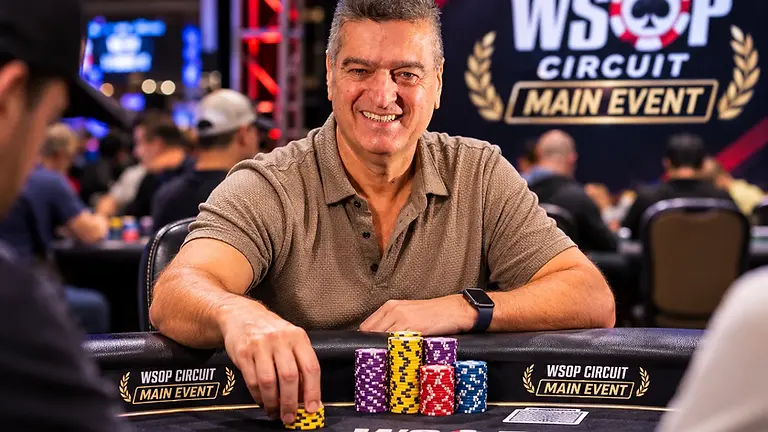
Original AI-generated illustrative portrayal selected for Hamid Izadi's WSOP Circuit story. The poker-table action, chips and WSOP Circuit backdrop are imagined; this is not an authentic photograph of Izadi or his 2026 Southern Indiana tournament.
Poker Pulse original AI-generated illustrative artwork — not an authentic event photograph.
Hamid Izadi defended his Southern Indiana WSOP Circuit Main Event title, beating Robert Hankins with ace-ten to claim his 11th ring and fourth Main Event crown.
The river paired the board again. Robert Hankins had moved all in with ace-six, Hamid Izadi had called with ace-ten, and the final five community cards read ace, king, seven, king, seven. Both players held two pair—aces and kings—but Izadi's ten played as the superior kicker. The last confrontation settled a title that had been pursued for days and completed a historic defence at Caesars Southern Indiana.
Izadi collected $93,060, his 11th WSOP Circuit gold ring and his fourth Circuit Main Event title after topping 282 entries in the $1,700 no-limit hold'em Main Event. The venue had never before had a player win its Circuit Main Event in consecutive editions, according to WSOP's official report. The winner in 2025 had returned in 2026 and finished on top again.
The result was more than another gold ring. It was a venue-first title defence, a record-equalling Main Event total and a final that brought two experienced Circuit competitors together across the table.
The field and the final-day advantage
The tournament generated a $427,230 prize pool, with 43 players in the money. Only nine reached the final day. Izadi arrived as the chip leader, having carried a strong stack through the late stages of the field's reduction.
A final-day chip lead is an advantage, not a championship. The last nine still contained players capable of reversing the order through the next few hands. The official live updates describe Izadi absorbing earlier setbacks before rebuilding; the final result was not obtained by simply being assigned the top stack at the start of a session.
Izadi's path also carried the burden of a previous win at the same stop. Defending a tournament is different from winning an unfamiliar event because the record already gives the player a target. Competitors know the reigning champion, and another deep run becomes a possible continuation of that history. It is a tempting setting for invented pressure or imagined table talk, neither of which is needed here.
The strongest evidence is in the field count, the final-table progression and the actual last hand.
A familiar opponent emerges at the end
As the final table narrowed, Brad Albrinck finished third for $43,680, leaving Izadi heads-up with Robert Hankins. Hankins was not a new name at this venue: contemporary coverage identifies him as a previous Southern Indiana Main Event champion from approximately a decade earlier.
The pairing therefore gave the final a genuine historical character. Izadi was defending last year's title and hunting a fourth Circuit Main Event win; Hankins had his own history at the same stop and the chance to add another victory.
The heads-up match began with Izadi holding a modest advantage. Hankins attempted to recover, but Izadi built the lead before the decisive confrontation. The eventual runner-up would receive $63,040, a confirmed payout in its own right. At the final table, however, the prize difference and the championship ring still had to be decided.
Ace-ten beats ace-six on a double-paired board
The finishing hand offers exactly the kind of detail that a sports report should preserve. With blinds at 40,000–80,000 and an 80,000 big-blind ante, Izadi raised from the button holding ace-ten suited. Hankins moved in with ace-six, and Izadi called.
The board ran A-K-7-K-7. An unfamiliar viewer could see the two pairs on the table and assume an automatic split, but the players' aces and kicker still mattered. Both made aces and kings, but Izadi could use his ten as the fifth card while Hankins' best fifth card was the seven on the board. That higher kicker gave Izadi the pot and the Main Event title.
That is a precise sporting outcome, not a vague claim that 'luck smiled on him.' There was no need to invent a last-second flush or a full house. The showdown's significance lies in the small difference between the two hands and the title that followed from it.
Four Circuit Main Events, eleven rings
WSOP's November report identifies Izadi's win as his fourth Circuit Main Event title, making him the second player in Circuit history to reach that total alongside Maurice Hawkins. The fourth Main Event achievement and the 11th overall ring are different statistics: the latter includes titles from other Circuit event formats.
This distinction matters because poker records are layered. One career total counts all rings; another counts Main Event victories; a third tracks individual venue titles and defences. Calling a player an eleven-time Main Event champion would be an error. Saying he has eleven rings and four Circuit Main Event titles gives the achievement its proper shape.
Izadi's earlier major stops included Harrah's Pompano Beach and Harrah's Cherokee, as well as the previous Southern Indiana win. The latest defence adds a special chapter because it happened in the same place and edition lineage as the year before.
His 2026 payout belongs specifically to the 282-entry event, not to the historical 2025 field. Any comparison between the two editions should use the separate official payout records rather than lift one year's totals into another.
Another Circuit champion, another future stage
The same week, WSOP crowned Scott Stewart at Caesars Republic Lake Tahoe, where Stewart secured his ninth Circuit ring. Both successes were announced together, but Izadi's title defence belongs in Southern Indiana; Stewart's river-call comeback belongs at Lake Tahoe. Separate fields and heads-up opponents produce separate stories.
WSOP also describes a $5,000 WSOP Paradise package for 2026 Circuit ring winners. That can create a future opportunity for eligible champions, but it does not establish a December tournament result. A confirmed Indiana Main Event victory should be celebrated for what has already happened, not turned into a promise about another field yet to assemble.
A title defence with an ending that deserves to be told
The closing record is unusually specific: Izadi beat Hankins heads-up, ace-ten against ace-six, to win $93,060, retain the Southern Indiana Main Event title and reach eleven Circuit rings. It tied the record for Circuit Main Event victories and gave the venue its first back-to-back champion.
A brief winner announcement can capture the cheque and trophy. The full story explains why the win belongs in the history books. The last pot looked close enough to be mistaken for a split; the kicker settled it, and a defending champion became a repeat champion on the same stage.
Primary sources
- WSOP: New Circuit Champions Crowned in Lake Tahoe and Indiana, 3 November 2026
- WSOP: official Southern Indiana $1,700 Main Event result
- Card Player: Izadi Goes Back-to-Back at Caesars Southern Indiana, 3 November 2026
Original Poker Pulse source-backed match report. Final-hand card sequence, opponent, prize amounts and historical ring distinctions follow published tournament reporting; no invented emotions or eyewitness access are claimed.
Editorial Sources
This report is based on independently written editorial analysis of sourced facts, not a republished source article.
Primary information sourceSource check: 6 Nov 2026
Keep reading

 PlayersIllustrative artwork
From Short Stack to Sprint Champion: Wilson Turns the Tables on Zamani for $110,600
Brock Wilson turned a short-stack struggle into a $110,600 PGT Sprint victory, overcoming Martin Zamani to earn his fifth tour title of 2026.
By Daniel Reed · AI-assisted desk
Players/1 day ago

 PlayersIllustrative artwork
Rheem Calls Down a Bluff, Then Wins With Seven-High to Take PGT Sprint Opener
A bluff catch with pocket tens flipped the final; Chino Rheem finished with seven-high to win PGT Sprint Event #1 and $119,600.
By Daniel Reed · AI-assisted desk
Players/1 day ago

 PlayersIllustrative artwork
Soverel Turns a Flopped Straight Into a Flush, Then Claims Record 18th PGT Title
Sam Soverel flopped the nut straight against Jeremy Becker, turned it into a river flush and claimed a record 18th PGT title worth $195,200.
By Daniel Reed · AI-assisted desk
Players/1 day ago