
The 2027 JOPT Season Starts in 2026: Tokyo's Holiday Festival Crosses the Calendar Line
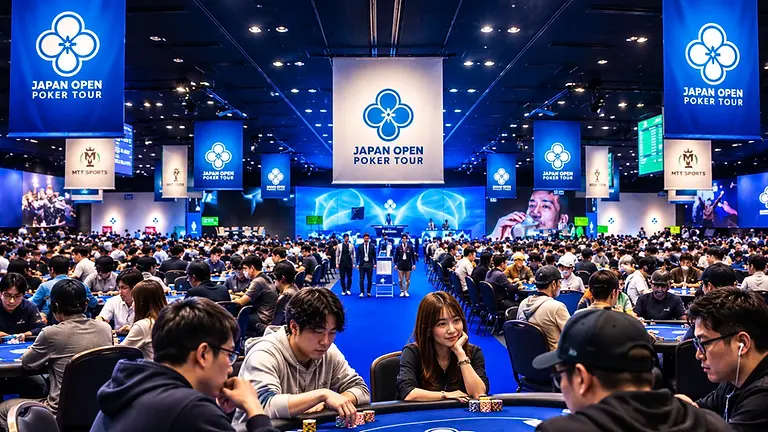
Original AI-generated editorial illustration informed by a user-supplied photograph of a 2025 Japan Open Poker Tour tournament. The imagined blue-felt tables, banners, players and tournament hall are not documentary photography of JOPT 2027 Tokyo #01 (24 December 2026–3 January 2027), nor a verified depiction of the Bellesalle Takadanobaba venue or 2027 competitors.
Poker Pulse original AI-generated illustrative artwork; visual research based on user-supplied JOPT 2025 imagery, not 2027 tournament photography.
JOPT’s Tokyo 2027 season begins before New Year’s Day, with an 11-day holiday festival at Bellesalle Takadanobaba that bridges two calendar years.
The title says 2027, but the first tournament dates fall before the end of 2026. Japan Open Poker Tour's 2027 Tokyo #01 is scheduled to begin on 24 December 2026 and continue through 3 January 2027 at Bellesalle Takadanobaba in Shinjuku. The event will span Christmas, New Year's Eve and the first weekend of January under a single official edition name.
That twist makes Tokyo one of the more intriguing dates on the year-end Asian poker calendar. A tournament labelled with the new season can already be under way while the old year is still on the clock. The winner's title belongs to 2027 Tokyo #01, even though portions of the qualifying programme are scheduled to occur in 2026.
For fans tracking results across the holiday period, a correct date is essential—but so is the exact event label. A field starting in December and concluding in January should not be split into two unrelated festivals or confused with the previous year's Tokyo edition.
A familiar Shinjuku venue on a long holiday run
JOPT's official event information identifies Bellesalle Takadanobaba, a large indoor event space in Tokyo's Shinjuku district. The venue page describes a roughly 2,400-square-metre hall with six-metre ceiling height and an open floor without internal columns, reached through a foyer and escalator access to the lower-level tournament area.
These are unusually useful details for understanding how a large festival can be staged. The venue's open floor allows tables and tournament areas to be organised without the physical obstacles of a heavily partitioned room. It is not evidence of how many players will ultimately enter the December 2026 edition; the final table count and attendance belong to the actual event record.
Bellesalle Takadanobaba has hosted earlier JOPT programmes. The organiser also lists 2026 Tokyo #01 as running 27 December 2025–4 January 2026. The pattern makes the 2027 edition easier to understand: the naming convention follows the tour season while the playing window bridges the year-end holiday.
Live and online routes feed the same Main Event story
The 2027 Tokyo event page explains that its Main Event offers separate routes into the live competition through live and online Day 1 pathways. The live instructions describe tickets obtained through satellites as well as direct-entry options, while the online opening-day route is addressed separately on the organiser's site.
For sports coverage, that distinction matters because a Main Event's story does not necessarily begin when the largest room fills. Players can reach later stages through different qualifying routes, and a list of opening-day sessions should not be confused with a count of distinct championship titles.
JOPT also advertises a wider programme of side events and different tournament formats. A side-event winner can earn a significant separate achievement, but the Main Event champion must be recorded under the Main Event's actual final result. As with any major multi-day series, a schedule can tell us what is planned while leaving outcomes open.
A calendar crossover creates genuine editorial challenges
The festival's name creates several easy mistakes. An article published in late December might refer casually to 'next year's Tokyo JOPT', even though the first scheduled days are already taking place. A January results article might call it a 2027 tournament without explaining that the start was in December. And a quick archive search could mistakenly group all 2026 December activity under the wrong edition.
The correct description is both simple and precise: JOPT 2027 Tokyo #01, scheduled 24 December 2026–3 January 2027, at Bellesalle Takadanobaba. Individual tournament results should then carry the date of the event that produced them.
The time zone is another small but important detail. The competition runs in Japan local time, while international poker audiences may read the opening and finishing dates from other continents. A hand reported shortly after midnight in Tokyo can still belong to the preceding calendar day for some followers overseas. A professional global scoreboard should use the organiser's local event time before converting it for readers.
The wider domestic season is already visible
The official JOPT calendar does not end in Tokyo. It lists 2027 Sapporo #01 for 28–31 January, 2027 Osaka #01 for 18–22 March, and 2027 Fukuoka #01 for 27–30 May. Those are separate future editions, at their own venues, not continuation days of the Tokyo holiday festival.
That gives regional readers a useful structure. Tokyo marks a holiday-season opening across the year boundary; later cities represent new stop identities. As participants move through the domestic circuit, results can be compared only after each event has actually produced confirmed winners and payouts.
The historical schedule also shows why edition numbers matter. JOPT has previously run other Tokyo stops during the same calendar year. 'Tokyo #01' is not shorthand for every JOPT tournament in Tokyo, and '2027' is not a claim that every playing day occurs after New Year's Day.
The sporting questions still to be answered
When the first confirmed sessions conclude, the fields, advancing players and later Main Event standings will give this preview its next chapter. The final-table lineup, decisive hands and champion will need official reporting rather than imaginative reconstruction. An advance calendar cannot establish any of those facts.
What it can establish is an unusual stage: a long Tokyo tournament programme running through the transition from one year to the next. That is already a better headline than a vague promise of 'the next big Japanese poker event'. The event has a name, a real venue, definite scheduled dates and a clear historical comparison. The winners still have to supply the ending.
Primary sources
- Japan Open Poker Tour: 2027 Tokyo #01 official event and venue details
- Japan Open Poker Tour: upcoming and historical event calendar
Original Poker Pulse Japan circuit preview. The year-crossing dates and venue are sourced; no invented field totals, champions, finishing hands or guaranteed prize pools are asserted.
Editorial Sources
This report is based on independently written editorial analysis of sourced facts, not a republished source article.
Primary information sourceSource check: 6 Nov 2026
Keep reading

 TournamentsIllustrative artwork
Trident Heads Back to Sea: Poseidon’s Crown Anchors December’s Four-Flight Main Event
After a recorded January soft launch, Trident returns to World Legacy on 4–6 December with a four-flight S$50,000-gross-guaranteed Main Event and two distinct side events.
By Maya Chen · AI-assisted desk
Tournaments/about 7 hours ago

 TournamentsIllustrative artwork
Three Festivals, Three Paths to a Title: Manila's 2027 Poker Season Takes Shape
From Super Series to Megastack and Okada Manila Millions, three distinct 2027 festivals give Manila poker fans separate championship races to follow.
By Maya Chen · AI-assisted desk
Tournaments/1 day ago

 TournamentsIllustrative artwork
Cambodia Opens WPT's 25th Season With Two Championships and Two Very Different Tests
Phnom Penh opens WPT Season 25 with two separate NagaWorld championships: a $500,000-guaranteed Prime event and the $1 million-guaranteed Main Tour contest.
By Maya Chen · AI-assisted desk
Tournaments/1 day ago