
The Poker World Has One News Feed—and Several Clocks
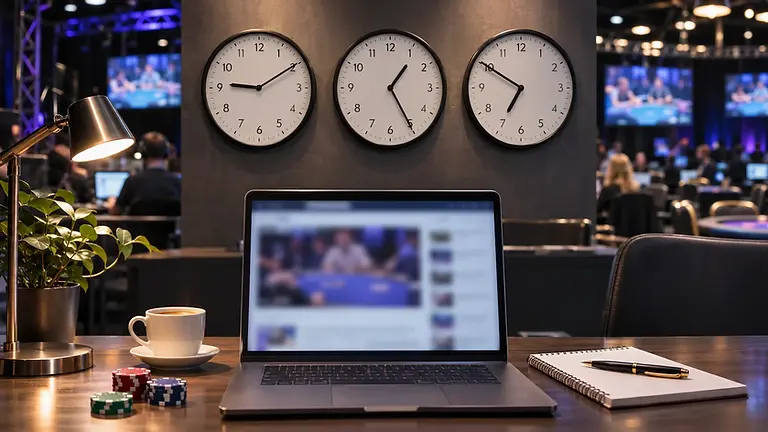
Original AI-generated editorial illustration of a poker newsroom with three symbolic analogue clocks. Neither the clocks nor the blurred screens represent actual live local times, tournament footage or reported scores.
Poker Pulse original AI-generated illustrative artwork; not event photography.
A global poker homepage can look live everywhere while its events unfold in different time zones.
The home page says 'breaking'. The event page says 'today'. A social post says a player has reached the final table. Yet the reader may be waking up in a country where that same session ended hours ago. This is the time-zone trap inside international poker coverage: a sport with one worldwide audience and many different local clocks.
On 5 November 2026, scheduled poker festivals span Seoul, Northern Cyprus and Las Vegas. The World Poker Tour lists a Seoul special event and its Venetian Fall Championship opening on that date; Triton ONE begins its Cyprus programme. They share a calendar day on paper, not a universal starting hour.
A date without a time zone is half a fact
A festival schedule is generally published for people attending the venue. Its start times are local. A reader in Singapore, London or New York may see the announcement at a different stage of the day. When the same article is syndicated or recirculated on social media, labels such as 'this evening' can become meaningless without the location.
Poker Pulse should therefore use a simple rule: important session times must be labelled in the venue's local time zone, or linked to the organiser's official schedule. A broad festival date range is not evidence of what is happening at a table at the moment the reader opens a page.
Three meanings of 'live'
A festival may be within its scheduled window. A particular event may be actively under way. A broadcast may be streaming live. All three can be described casually as 'live', but they are not the same thing.
This is more than a vocabulary exercise. Suppose a tournament lasts ten days. Its Main Event may begin on Day 6. Calling the Main Event 'live' from the first day of the festival would misrepresent the schedule, even though a separate side event may indeed be in play.
A replay of yesterday's final table creates another complication. The video is available now, but the result was decided earlier. A responsible news report should not imply that the title is still being contested.
The wrong winner can appear under the right brand
Time-zone confusion combines with tournament identity confusion. WPT's Seoul special event and the Venetian Main Tour event both carry WPT branding. A push notification saying 'WPT winner crowned' becomes ambiguous unless it gives the precise stop and competition.
The same issue occurs when Triton ONE and the Triton Super High Roller Series share a destination but have separate schedules. Location, brand and event title must accompany a result if the reader is to understand it accurately.
What a sports-style homepage should do
We like the visual drama of a broadcast screen: a bold hero, a breaking-news rail and a strong upcoming-events panel. Those elements should serve genuine information rather than manufacture urgency. An event that has not yet started can be exciting without being labelled as an ongoing contest. A verified result can remain important hours after the tournament ended.
A better set of signals is modest and precise: Scheduled, Festival window, Result confirmed, Cancelled, and, where independently available, Live reporting. A badge should reflect a source status, not simply an animation on the page.
When the same headline lands in three mornings
A November update illustrates the problem. WPT Seoul, Triton ONE North Cyprus and WPT Venetian Las Vegas all have activity beginning on 5 November on their official schedules. In Korea, the day's local clock reaches its afternoon hours before a reader in Nevada reaches the same date. In Cyprus, the sessions follow yet another local timetable.
A global headline saying that all three are “starting tonight” would therefore be wrong for much of its audience. Better wording is precise about the event and its location: the WPT special event is scheduled in South Korea, Triton ONE has a Northern Cyprus festival window, and a separate WPT Main Tour stop begins at the Venetian.
That is not less exciting. It helps the reader follow the real competition rather than a dramatic but ambiguous clock graphic. It also prevents an update originally written for one market from being misunderstood when reposted elsewhere.
A result has a time; a schedule has a window
A completed tournament has an official finish, but a festival window may stretch across a week or more. The two are not interchangeable. GOP Incheon II, for example, has a published festival period through 8 November; it does not mean that every event in its 76-event programme is in progress at every hour.
Similarly, the APT Championship Taipei schedule begins on 13 November and extends through 29 November. A story about the November championship should identify which competition or flight it is covering. A result from another APT event cannot be imported just because it shares the brand.
The most useful sports ticker would show a short hierarchy: organiser, event, venue, local date, then status. For a finished contest it would add the confirmed champion and payout. For an upcoming festival it would retain the word scheduled. For a cancelled event, such as GOP's December Jeju stop, it would show cancelled even when an older graphic is still circulating.
The discipline behind a dramatic front page
This is the editorial opportunity for Poker Pulse. A fan can move from the latest result to a tournament preview with the same sense of immediacy a sports broadcast provides, while always knowing which claims are verified.
Date-stamping the story, linking the exact organiser record and avoiding invented live-play signals are not restrictions on good storytelling. They make it possible to put the dramatic moment in the right event, on the right date, rather than borrowing urgency from a different time zone.
Local detail is global value
International poker media has a chance to give readers clarity they may not get from scattered promotional posts. The organiser's local clock, the exact event being discussed and a timestamp on a report tell an honest story. They also make the site more useful to readers who follow several circuits across a single day.
The excitement is real. It just does not happen at the same hour everywhere.
Sources
Poker Pulse Features Desk. Original industry commentary supported by published organiser schedules.
Editorial Sources
This report is based on independently written editorial analysis of sourced facts, not a republished source article.
Primary information sourceSource check: 6 Nov 2026
Keep reading

 Poker StoriesIllustrative artwork
Beyond the Big Number: What Tournament Headlines Leave Out
The largest guarantee is not necessarily the most useful fact when comparing two poker festivals.
By Sophie Laurent · AI-assisted desk
Poker Stories/1 day ago

 Poker StoriesIllustrative artwork
Two Circuit Winners, Two Very Different Milestones
Hamid Izadi's Southern Indiana repeat and Scott Stewart's Lake Tahoe title show why the story is bigger than one results ticker.
By Sophie Laurent · AI-assisted desk
Poker Stories/1 day ago

 Poker StoriesIllustrative artwork
The Vanishing Festival: Why Tournament Cancellations Matter
A withdrawn event can continue living online long after the organiser has changed the calendar.
By Sophie Laurent · AI-assisted desk
Poker Stories/1 day ago