
Two Circuit Winners, Two Very Different Milestones
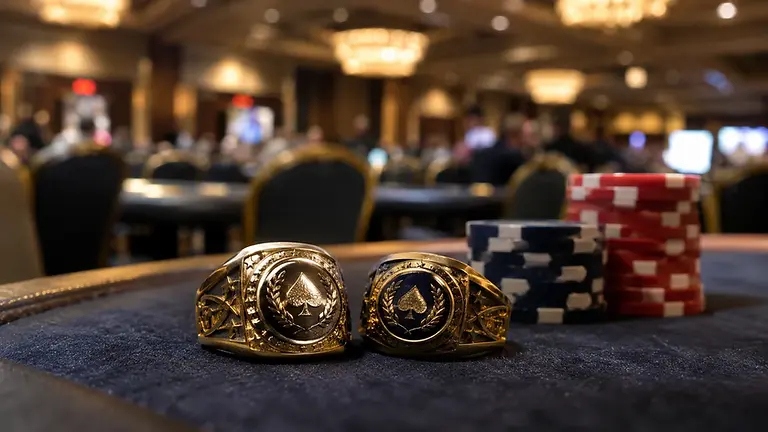
AI-generated symbolic illustration of two gold poker championship rings; not the actual WSOP Circuit rings awarded to Hamid Izadi or Scott Stewart.
Poker Pulse original AI-generated illustrative artwork — not event photography.
Hamid Izadi's Southern Indiana repeat and Scott Stewart's Lake Tahoe title show why the story is bigger than one results ticker.
On the same day, the World Series of Poker announced two Circuit Main Event champions. It would have been easy to write a single brief, put both names in the headline, add two prize amounts and move on. Yet Hamid Izadi and Scott Stewart had achieved different kinds of milestones at different tournaments. The two stories deserved more than a shared results box.
Izadi defended his Main Event title at Caesars Southern Indiana, winning $93,060 from 282 entries and bringing his career Circuit ring count to 11. Stewart won at Caesars Republic Lake Tahoe, taking $125,279 from a 435-entry field and earning his ninth ring.
The numbers alone tell us the tournaments were not interchangeable. The history behind them goes further.
A successful defence is its own sporting achievement
A poker player cannot defend a championship by repeating the previous year's cards. Every edition begins again. New opponents enter, cards fall differently, and the decisive moments are not guaranteed to resemble the earlier win.
That is what makes Izadi's Southern Indiana repeat notable. The organiser says he became the first player to win consecutive Main Event titles at that venue. It also reports that the victory was his fourth WSOP Circuit Main Event title, making him the second player to reach that achievement after Maurice Hawkins.
The official report describes a final duel against Robert Hankins. The two men were longtime friends, according to the organiser, which lends the heads-up contest a human dimension. Izadi's ace-ten ultimately defeated Hankins' ace-six to close the tournament. The result is established; their private thoughts at the table are not, and there is no need to invent a quotation to make the scene compelling.
Stewart's ninth ring deserves its own spotlight
At Lake Tahoe, Scott Stewart faced a larger field and a different route to the trophy. WSOP's account identifies a key river call against Tyler Parker during heads-up play. Stewart called an all-in with a full house, built an advantage and went on to win.
Parker finished second, and the official final-table reporting also included Harshvardhan Baghel in third and Ari Engel in fourth. Those placements give the Lake Tahoe event a competitive shape of its own, separate from the Southern Indiana finish.
Stewart's ninth ring is a career milestone. It belongs to his Circuit record, not to Izadi's. That separation may sound obvious, yet fast news feeds often bury it under generic language about the Circuit having a 'big weekend'.
What a results archive can preserve
Poker careers are built across many tournaments, and the historical record matters to how achievements are understood. A title is defined by a specific organiser, event name, buy-in, location and date. When any of those details are carelessly merged, later comparisons become less reliable.
A good archive should let a reader answer precise questions. How many entries did Izadi defeat at Southern Indiana? Which venue hosted Stewart's ninth ring? Who finished second in each event? What amount was actually awarded to first place? Those are verifiable answers, not subjective impressions.
The hands that gave each final its identity
At Southern Indiana, the last confrontation was shaped by a striking personal detail: according to the WSOP, Izadi and Robert Hankins were longtime friends. That history makes the finish more memorable, but it cannot be used to invent their conversations or emotions at the table. The documented showdown is compelling enough. Izadi's ace-ten prevailed against Hankins' ace-six, sealing the repeat championship and his fourth career Circuit Main Event win.
At Lake Tahoe, Stewart's crucial moment came in a different form. Facing Tyler Parker heads-up, Stewart made a consequential river call with a full house against an all-in wager. The reported hand shifted the balance, helping Stewart move toward the trophy. The official finishing order placed Parker second, Harshvardhan Baghel third and Ari Engel fourth.
Those are two very different sporting sequences. One concludes with a title defence against a familiar opponent. The other turns on a pressure decision late in a separate tournament. Packaging them as “two WSOP winners” is factually acceptable but leaves out the part readers are most likely to remember.
What the two fields tell us—and what they don't
Lake Tahoe drew 435 entries, compared with 282 at Southern Indiana. Stewart earned the larger first-place payment, $125,279, while Izadi received $93,060. A comparison of those figures cannot establish that one title was harder to win. Field sizes, tournament structures, opponents, buy-ins and blind progressions all affect the path through an event, and the official summary does not supply a universal difficulty score.
What we can compare is the nature of the milestone. Izadi's eleventh ring adds to an already exceptional Circuit tally and follows a successful defence at the same stop. Stewart's ninth ring is another major career landmark, with a documented pressure hand at the decisive stage.
That is how a results feature should build a wider story: first the specific contest, then the player's career, then the circuit context. The sporting achievement remains the headline, and the comparison adds depth without producing an imaginary ranking between the two champions.
Two winners, one wider circuit story
The shared announcement still has value. The two results connect to the broader WSOP Circuit season and the year-end road toward WSOP Paradise. That is where a roundup belongs: after each event has been correctly recorded, showing how separate champions fit into the larger calendar.
The beauty of poker storytelling is that the structure permits both scales. There is the hand that decides a title, the tournament that produces the winner, and the wider career that gives the result meaning. Izadi and Stewart offered different versions of that same sporting progression.
Two champions were crowned. Neither should be reduced to the other's footnote.
Source
Poker Pulse Features Desk. Original historical and sporting analysis based on the governing organiser's report.
Editorial Sources
This report is based on independently written editorial analysis of sourced facts, not a republished source article.
Primary information sourceSource check: 6 Nov 2026
Keep reading

 Poker StoriesIllustrative artwork
The Poker World Has One News Feed—and Several Clocks
A global poker homepage can look live everywhere while its events unfold in different time zones.
By Sophie Laurent · AI-assisted desk
Poker Stories/1 day ago

 Poker StoriesIllustrative artwork
Beyond the Big Number: What Tournament Headlines Leave Out
The largest guarantee is not necessarily the most useful fact when comparing two poker festivals.
By Sophie Laurent · AI-assisted desk
Poker Stories/1 day ago

 Poker StoriesIllustrative artwork
The Vanishing Festival: Why Tournament Cancellations Matter
A withdrawn event can continue living online long after the organiser has changed the calendar.
By Sophie Laurent · AI-assisted desk
Poker Stories/1 day ago