
The Vanishing Festival: Why Tournament Cancellations Matter
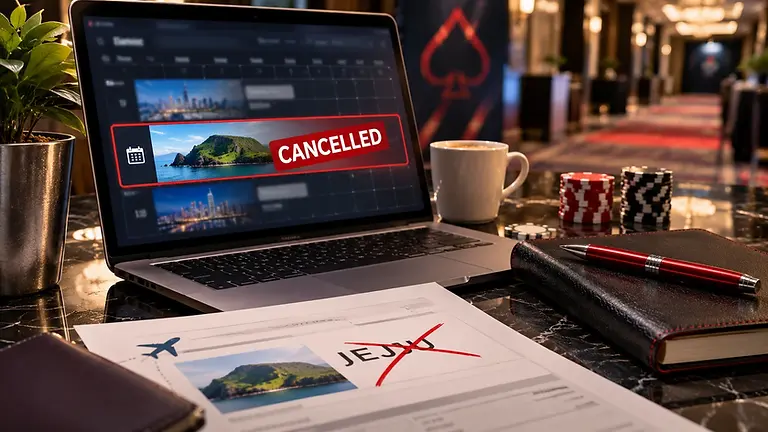
Original AI-generated editorial illustration of a cancelled Jeju poker-festival calendar, inspired by the organiser’s 7 October 2026 cancellation announcement. The desk, venue corridor, landscape and screen are conceptual, not documentary event photography.
Original AI-generated conceptual editorial illustration for The Poker Pulse; not verified event photography.
A withdrawn event can continue living online long after the organiser has changed the calendar.
An event poster can look permanent. The dates are neatly printed, the venue is pictured, the logo is polished and the promise of a major festival feels settled. But the event may no longer exist by the time that image reaches another person's phone.
Gods of Poker's cancelled December 2026 Jeju festival is a vivid example. The organiser had originally planned an event from 4–13 December. On 7 October, it announced that the festival would not take place, and confirmed Incheon, 30 October–8 November, as its last 2026 stop.
Those two facts belong together: one planned event was withdrawn, another remained on the calendar. Yet a simple tournament directory can lose that nuance surprisingly quickly.
Why old dates keep circulating
A festival can be announced months before it begins. Third-party event calendars index it. Community groups share promotional graphics. Search engines preserve copies, and media outlets publish advance previews. Once that information spreads, a later correction has to travel through many of the same channels to reach everyone who saw the original plan.
There is no reason to assume a reader following an old link has also seen the cancellation notice. If a directory simply displays the previous Jeju dates as 'upcoming', it is no longer providing neutral information. It is preserving an outdated claim in a form that looks current.
The official notice must take priority
GOP's October announcement was direct: the December Jeju stop would not go ahead. The organiser acknowledged the disruption and said it intended a more concentrated 2027 schedule. It did not provide a replacement Jeju date in that notice.
That last distinction matters. A planned future direction is not the same as a confirmed future event. The temptation to fill a gap with a plausible new location or approximate dates should be resisted. If the organiser has not said where and when, the correct entry is 'not yet announced'.
A cancellation is still a historical fact
Removing a cancelled festival completely can create a different problem. A reader researching an old announcement might wonder why the event disappeared. A good archive can retain the original planned dates while marking them unmistakably as cancelled and linking to the source that explains why.
This is how a publication can become a dependable reference over time. We preserve the history without inviting readers to treat it as the current schedule. The same principle applies when an event is postponed, moved to another venue or renamed.
What the Incheon replacement means—and what it does not
GOP identified its Incheon meeting as the final festival of 2026. It was not described as a replacement Jeju event under a new name. Incheon has its own schedule and tournament titles at Paradise City. Treating it as though the Jeju festival simply relocated would impose a story the organiser did not establish.
Incheon itself has competitive news to follow, including its published 76-event programme and a Main Event. Those are separate facts from the cancellation. The two are connected in the season narrative, not identical in tournament history.
The stakes extend beyond a calendar entry
A festival announcement travels through several audiences at once. A competitor may be comparing schedules; a fan may be following a favourite player's potential next stop; a publisher may have pencilled the dates into a weekly preview. Each group is exposed to a different risk when an old announcement remains visible after cancellation.
The most useful correction is therefore one that answers practical questions in plain language. Was the event cancelled or postponed? Did the organiser provide replacement dates? Which festival, if any, remains confirmed? For GOP's December Jeju stop, the answer to the first is cancelled, the second is no replacement date in the cited announcement, and the third is the already scheduled Incheon festival.
That is not an argument that every cancellation should become a front-page scandal. The reasons and consequences need reliable evidence. The organiser's notice is sufficient to establish the change of status; it does not, by itself, prove claims about refunds, financial losses, behind-the-scenes disputes or the motives of any participant.
How an accurate archive should look one year later
Imagine a reader in 2027 trying to determine whether a champion won a December 2026 GOP event in Jeju. A trustworthy archive should make the answer immediate: the planned event did not occur, the old date range is preserved only for historical context, and the organiser's 7 October 2026 cancellation statement explains the change.
The corresponding Incheon result archive should remain entirely separate. Paradise City hosted its own programme from 30 October to 8 November. It was the final scheduled GOP festival of 2026 after the Jeju cancellation, not a tournament rescheduled from the island.
That distinction protects the careers of actual winners as well. A title won at Incheon must not migrate into a fictitious Jeju record merely because a directory attempts to fill its empty December slot.
Why corrections can become a competitive advantage
Readers will return to a sports site that distinguishes confirmed evidence from attractive but obsolete announcements. Source dates, visible status labels and an explanation of significant changes create that confidence. A cancellation article can be as valuable as a winner article when it prevents someone from following a tournament that no longer exists.
In this case the interesting final result will come from the last Incheon festival, not from the tournament Jeju was once expected to stage. The absence itself is now part of the season's documented history.
Corrections as part of the brand
Sports journalism often celebrates certainty. A winner crosses the line; a trophy is handed over; the scoreboard updates. Scheduling news is less tidy. Dates change, plans evolve and different versions of a poster remain in circulation.
The Poker Pulse will therefore keep a source-linked correction trail. If we previously listed an event as upcoming and the organiser cancels it, the status should change to cancelled. If an earlier article contains a material error, a visible correction should explain the change rather than silently replace the relevant sentence.
The test of a useful poker news site is not whether every advance announcement survives unchanged. It is how quickly and clearly the publication corrects the record when reality changes.
Sources
The Poker Pulse Features Desk. Original editorial analysis of an organiser correction, checked 5 November 2026.
Editorial Sources
This report is based on independently written editorial analysis of sourced facts, not a republished source article.
Primary information sourceSource check: 6 Nov 2026
Explore The Poker Pulse
Continue with reporting and reference pages related to this story.
Spot an error or have a correction or documented news tip? Contact the editorial desk.
Keep reading

 Poker StoriesIllustrative artwork
The Poker World Has One News Feed—and Several Clocks
A global poker homepage can look live everywhere while its events unfold in different time zones.
By Sophie Laurent · AI-assisted desk
Poker Stories/2 days ago

 Poker StoriesIllustrative artwork
Beyond the Big Number: What Tournament Headlines Leave Out
The largest guarantee is not necessarily the most useful fact when comparing two poker festivals.
By Sophie Laurent · AI-assisted desk
Poker Stories/2 days ago

 Poker StoriesIllustrative artwork
Two Circuit Winners, Two Very Different Milestones
Hamid Izadi's Southern Indiana repeat and Scott Stewart's Lake Tahoe title show why the story is bigger than one results ticker.
By Sophie Laurent · AI-assisted desk
Poker Stories/2 days ago